
Classical Education To Achieve A Thoroughly Christian Mission
Happy is the man who finds wisdom, And the man who gains understanding; Proverbs 3:13

Lifelong Learning
Truth, Beauty, Goodness
Classical Christian education prepares students for life, not merely for college or a career. Our hope is that our students will learn to recognize that all that is good, beautiful, and true in the world finds its source in God. We study the great books in the light of the greatest book.
Our concept of classical Christian education could be described as Christian in mission and classical in method. The classical model focuses on a child’s natural stages of development, known as the Trivium, which roughly correlates to the elementary, middle, and high school years.
The most essential quality of our faculty is love. The classroom environment should reflect a lived-out gospel, modeled by the adults and characterized by respect, discipline, and order, but not such rigidity that students will not find and express joy in the learning process.
We believe that science reveals God’s creation, history is His story, math describes His majesty, literature, art, and music celebrate His love, wisdom, justice, and beauty, and physical education is possible because it is in Him we live and move and have our being.
Our desire and belief is that our application of classical Christian education will produce life-long learners and critical thinkers able to discern good from evil, beauty from ugliness, truth from fallacy, and wisdom from folly.
The Trivium Model
3 Critical Stages of Learning
Classical Christian education focuses on equipping and preparing children for the future with what has been proven successful in the past. The roots of classical education can be traced back to the Greeks, just prior to the time of Christ. As the gospel spread around the world, the early Christians developed an educational model that continued through the early 1920’s.
The classical method is built on a three-part framework known as the Trivium. The three foundational stages are Grammar, Logic, and Rhetoric and each correspond to the three primary stages of a child’s development.
1. Grammar Stage (K5-5th Grade): Knowledge
- Subjects Focused On:
- Biblical stories and scripture passages.
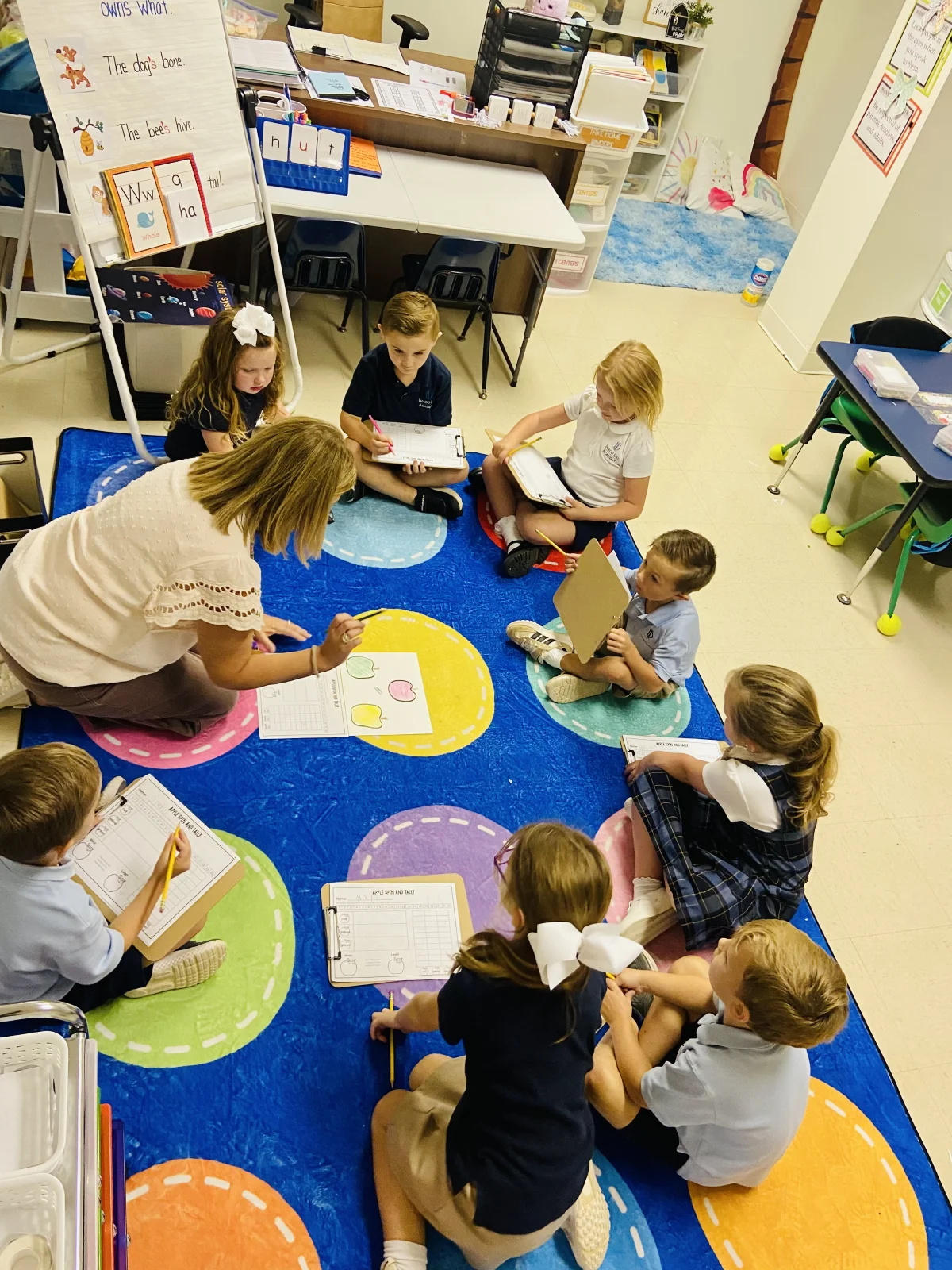
- Language basics, including phonics, reading, writing, and “Little Latin”.
- Math fundamentals and science exploration.
- Key Methods:
- Songs, chants, storytelling, and hands-on activities.
2. Logic Stage (6th-8th Grade): Understanding
As students enter adolescence, they naturally become curious and questioning. The Logic Stage harnesses this by teaching reasoning and analytical skills.
- Subjects Focused On:
- Advanced math and problem-solving techniques.
- Debates and structured arguments in literature and history.
- Understanding cause-and-effect relationships in science and theology.
- Key Methods:
- Discussions, debates, and logic exercises.
3. Rhetoric Stage (9th-12th Grade): Wisdom
In the final stage, students are taught to articulate their thoughts with clarity and persuasion. This stage builds on the knowledge and reasoning developed earlier.
- Subjects Focused On:
- Writing and presenting research through a biblical lens.
- Senior thesis projects that require deep analysis and public defense.
- Studying classical texts to enhance eloquence and understanding.
- Key Methods:
- Public speaking, essay writing, and mentoring.
What Does Imago Dei Mean?
Invest In Your Child's Future
Wise and Virtuous Living
The Classical Difference
Classical education does not just fill students with facts in order to pass the next test or to earn a degree, we have higher ambitions. As we embark to teach students how to think and not just what to think, we understand that our education influences our worldview and affections. This philosophy aims at teaching for wisdom and virtue rather than knowledge alone, and shifts the focus of education to who we become, not what we know.
If our goal is to graduate lifelong learners, then we must not only consider the mind, but also the heart. To forsake how our affections interact with truth and ideas would be to reject the command given in Philippians 4:8:
“Finally, brothers, whatever is true, whatever is honorable, whatever is just, whatever is pure, whatever is lovely, whatever is commendable, if there is any excellence, if there is anything worthy of praise, think about these things.”
A Connected Education
Classical Christian education stresses the interconnectivity between subjects, emphasizing a holistic understanding of truth as unified under God’s sovereignty. As a practical example, consider the Scientific Revolution. In history, students will explore the cultural and intellectual shifts that led to groundbreaking discoveries by figures like Copernicus, Kepler, and Newton.
In science, students learn about Kepler’s laws of planetary motion and Newton’s laws of motion and universal gravitation, observing how these discoveries reveal the order and complexity of the universe that reflects God’s design. In math, students may delve into the mathematics behind these discoveries, such as Kepler’s use of geometry to describe planetary orbits or Newton’s application of calculus to explain motion.
Throughout this interconnected approach, teachers will highlight how a Christian worldview influenced these scientists who pointed to a rational Creator, and how these different subjects work together to reveal the order and beauty of God’s creation.
Recommended Reading List for Parents
Here is a list recommended books that provide a deeper knowledge of the classical Christian model and further insight into the principles that will guide our teachers and administration. The books marked with an * are the best places to start for those who are new to the concept of classical Christian education.
- *An Introduction to Classical Education: A Guide for Parents – Dr. Christopher A. Perrin (available here)
- * Wisdom and Eloquence for Parents - Robert Littlejohn & Charles T. Evans
- Battle for the American Mind - Pete Hegseth & David Goodwin
- The Lost Tools of Learning – Dorothy Sayers
- Foundations for Lifelong Learning: Education in Serious Joy – John Piper
- The Abolition of Man – C.S. Lewis
- Classical Me, Classical Thee: Squander Not Thine Education – Rebekah Merkle
“I believe in Christianity as I believe the sun has risen, not only because I see it, but by it I see everything else.” -C.S. Lewis
Join the Imago Dei Family!
Below you will find an overview of the 3 steps involved in the Imago Dei admissions process.
Online Application
Start by creating an account and fill out the online application. Included will be your one-time $150 application fee (non-refundable).
While not mandatory, we encourage all families to schedule a tour and experience Imago Dei.
To schedule a tour, contact our office at
(205) 265-1554 or
admissions@imagodei-academy.org.
Student Evaluation
Following your application, we will schedule a student evaluation where your child will interact with teachers and peers in our school environment.
Join us on December 10th at 6:00pm for a discussion on how to prepare your child for kindergarten. This event is open to families with children from birth to age five.
Parent Interview
We will schedule an informal meeting as a way for our staff to learn more about your family and for you to ask any further questions.
Following parent interviews, families will be notified of the acceptance decisions. Enrollment packets will then be distributed to complete that will reserve your child's seat in the classroom.